Showing posts with label polyhouse. Show all posts

Friday, 1 August 2014

A warm place to work out of the rain,hail and wind

Awoke to large piles ofP8011462 icy hail around the place , 43.5 mm  in the rain gauge for the past 24 hours and more rain,hail and wind on the way I headed to the polyhouse to get things done.Normally in winter polyhouse there are daily harvests of greens for us and the chooks. Our flock require a large basket  full of greens to be blended into their mash daily and the outside gardens never grow fast enough in winter to keep up.


This year has been quite different as I was out of action from Spring to Autumn with firstly with a broken leg (Thanks to neighbours goat, which is still managing to climb the fence to my vegies garden.) Then a new knee! Over this time the polyhouse became covered in lovegrass whose seeds latch on to your clothes and was proberly responsible for the invention of Velcro. To remove this weed required me to wear a polyester type bee suit,and long gumboots and still some seeds ended up on my socks.Once removed the beds where dug over to removeP8011465 invading roots , the soil had mineralized , which means when you push the spade in you hear a crunching sound similar to putting a spade into gravel or the grittiness of potting soil or when  compost has been left too  long.

It was now late May and getting too late to plant most things even in side.

The two centre beds had some of my humus rich  compost dug in and where planted with brought in brassicas seedings and lettuce,kale and silver beet seedlings from my garden. The outside beds where left dug over and watered to get the weeds to germinate and today I dug them in as a green manure and then stirred some biodynamic barrel compost and treated all the beds. Next week I will dig in some  humus rich  compost and do another stirring of barrel compost and it will be ready for spring planting  and some  biodynamic 500  to get an early start  for the summer vegies.

Monday, 17 September 2012

Vegetables for the table year round.

The first thing you notice about my home vegetable garden is that it is well fenced to keep poultry and dogs out.OLYMPUS DIGITAL CAMERA

The large banana passionfruit vine is a good deterrent as they can’t see through and see what they are missing.

As you enter there is always a vast array of vegies, some growing, some ready for the table and some going to seed to ensure future crops.

OLYMPUS DIGITAL CAMERA

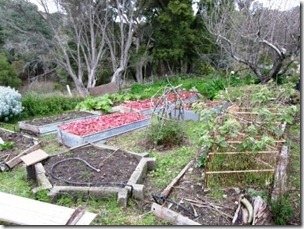
Established in 1983 the annual  garden is 10 x 18 m and includes a tool shed (in need of new door!) propagation area, cold frames and its own compost area.

THIS VEGETABLE GARDEN IS DESIGNED TO PRODUCE A STEADY SUPPLY OF TOP QUALITY PRODUCE WITH MINIMUM WORK.

THE BASIC FEATURES ARE :

*PERMANENT RAISED BEDS. The soil from pathways was used to build beds. Each bed is enclosed to keep soil in. The width of the bed ensures easy reach. GARDEN BEDS SHOULD NEVER BE WALKED ON!!!!

*VEGETABLES ARE GROWN IN SOIL ENRICHED WITH OUR OWN BIO DYNAMIC COMPOST.

* EACH BED HAS ITS OWN IRRIGATION SYSTEM.

*THE SOIL TILTH REQUIRES MINIMAL EFFORT IN CULTIVATION. WEEDS ARE EASILY HAND PULLED, SOIL RAKED & THEN SEEDS PLANTED.

*THE AREA IS KEPT IN BALANCE BY PROVIDING HABITAT AREAS AROUND THE PERIMETER (THE WILD AREA) FOR BENEFICIAL CREATURES.

SEED+ SOIL+COMPOST+WATER+SUNLIGHT=HEALTHY VEGETABLES

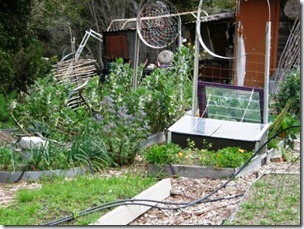
Cold frame & parsley
OLYMPUS DIGITAL CAMERA
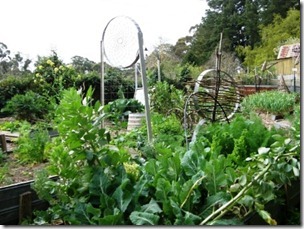
Broad beans & broccoli
Broad beans
There is always something for the table.
OLYMPUS DIGITAL CAMERA
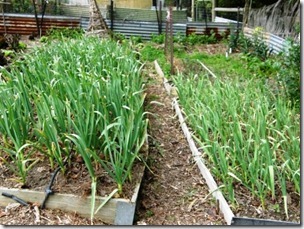
Garlic crop
OLYMPUS DIGITAL CAMERA
Garlic & chicory. Meals revolve around what’s in the garden mixed with what has been preserved.
OLYMPUS DIGITAL CAMERA
Flowering turnips
OLYMPUS DIGITAL CAMERA
miners lettuce & mache
OLYMPUS DIGITAL CAMERA
Green wave mustard
OLYMPUS DIGITAL CAMERA
Cabbage
OLYMPUS DIGITAL CAMERA
Kale
OLYMPUS DIGITAL CAMERA
Snow peas
OLYMPUS DIGITAL CAMERA
Cardoon
OLYMPUS DIGITAL CAMERA
New round garden fed and watered by worm farm
OLYMPUS DIGITAL CAMERA
Borage grows wild throughout the garden. Great for attracting bees. 
OLYMPUS DIGITAL CAMERA

Behind this area is the perennial garden and herbs. Perennial plants need different attention so it made sense to separate them.This is a relatively new garden established in 2000.A fenced off area 12x 10m which contained 5 old apple trees, sour sobs, other bulbs, grasses and clovers. The area received the morning sun especially after the removal of a large pine on adjoining property.Artichokes, rhubarb, strawberries,asparagus,hops, comfrey, nettles, rue,wormwood, valerian and 1 apple tree all share this garden.Camellia flowers provide a great fairy carpet mulch.
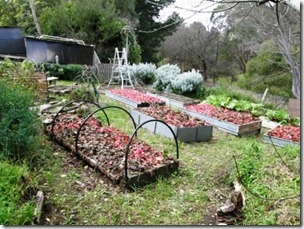
perennial gardenearly spring

tunnel houseThe successful growing seasons can be simply extended by the use of cold frames which are easily constructed and a 6 x 4m tunnel which is a thin sheet of plastic which can keep plants growing during the cold wet winters. Although many things grow outside in winter they are often sitting there which is great for the root crops that get sweeter but lettuce just gets bitter so its ideal for indoor growing.Capsicums never ripen outdoors here so they do well along with the sweet potatoes and ginger. There is also a heated propagation area to get summer veg off to a early start.

cold frame   inside tunnel house

Want to learn more about producing  vegies for your table everyday and how to grow them successfully using proper organic methods.Deb shares 30 + years of experience of how to do it easily. Workshop Details


Monday, 5 July 2010

Winter in the polyhouse

The winter garden excels in quality and taste . The winter chill produces sweet crunchy carrots, parsnips, turnips, beetroot and salsify all planted in February and March ,all perfect for winter stews, soups and roasts. The range of greens is equally impressive but the cold has slowed their growth to the extent that they are not growing as fast as we (and the chooks) consume them. Crunchy salads are part of most meals even in winter.To ensure a continual supply of crisp greens I move some seedling from the garden into the polyhouse.
OLYMPUS DIGITAL CAMERA
It is amazing how a thin piece of plastic can change the growing conditions. Wind chill and cold temperatures outside, inside toasty warm.The polyhouse is 7 x 4 metres and contains around 15 square metres of in ground growing space and a propagating area. The beds are 80cm wide –one goes around the edge and then there are 2 beds in the centre.Between the beds are narrow 30 cm paths made from tiles and pavers. These help define the beds and add some thermal mass as well. Increasing the thermal mass using water storage works well to collect the passive heat when the polyhouse is hot and releasing the energy when it cools.


OLYMPUS DIGITAL CAMERA
Gardeners are the guardians of the plants in the gardens they create. In the natural environment of the plant world is created with beauty and purity. In the polyhouse the gardener has to provide the same wisdom to bring about a sense of beauty , develop a healthy ecosystem and reflect order throughout.This is an artificial environment established to grow plants.

Tips to ensure a healthy growing environment in the polyhouse.
The polyhouse is the opposite to the composting area and as growing is the opposite to decaying the inside of the polyhouse has to be kept clean.
  • All dead plant material should be removed to the compost .
  • Keep windows and walls clean remove algae and grime.
  • treat woodwork to prevent decay .
  • Keep clear of things that do not belong.
WATER Rain needs to be replaced in this artificial environment. Water sustains plant life and combined with light and warmth determines growth rates. Humidity needs to be controlled without developing fungal diseases. Water can be supplied via hoses, drippers , sprinklers or watering can .The garden beds have both a dripper system and a sprinkler mounted on the roof can be a substitute for rain drops. These are mainly used in the warmer weather where as in winter a watering can is sufficient.
Winter watering is best done first thing in the morning and leaves need to be dry by sunset to avoid plant diseases.A good rule is to water every sunny day-as it increases humidity , sunny days increase air temperature and raise evaporation of the soil.
During the warmer months the watering is more demanding and the drippers and sprinkler are both utilized for humidly , temperature control as well as irrigation.
SOIL I prefer to grow my plants in quality soil of good tilth, developed by adding quality humus rich compost. The biodynamic preparations are all used, after all I’m growing our food and to be of any value to our body and mind it needs to be nourished by the earth.
Soil in the polyhouse is a challenge to manage as there is no rain to develop the soil and artificial watering is never the same. The soil has a tendency to compact with artificial watering and hot +30o C cause the soil to mineralize especially if there is not enough moisture available.
Because this is an artificial environment I always add fresh compost to the beds before each crop. The compost has to be broken down to humus as growing is the opposite to decaying.Artificial environments can cause all sorts of problems if the soil is not managed. The soil needs some light cultivation every now and then to counter act the compaction.I use a ho-mi or just my fingers to lightly tickle the soil.
Over summer a heavy straw mulch is required to protect the soil. This should be removed when the weather cools.

Mini stiring 002
USING BIODYNAMIC METHODS IN THE POLYHOUSE. The soil is enriched with biodynamic compost as well the full range of preparations are use . In practice the best way is to treat the polyhouse at the same time as your doing the outside gardens.When seedling are transplanted dilute liquid manure (mostly nettle,barrel compost and casuarina )is watered on for the first 3 days.
In addition use a range of sprays to support and strengthen growth forces.The plants are offered forces inherent in spray materials which work to overcome the deficiency of sun forces in the polyhouse.This results in maintaining plant growth healthy enough to shrug off diseases and undesirable insects.
The sprays are used in small amounts –a light mist spray is sufficient.A weekly spray of either valerian (BD507) nettle tea,camomile tea, casuarina.Each is stirred biodynamically for 10 minutes. I stir a couple of drops in 250ml water in a little bowl and use a simple household spray bottle.

ECO SYSTEM As we are working with an artificial environment it important to develop a balanced ecosystem to overcome weakness that occur. The bigger the diversity of plants the better- always add some flowers.Observe and encourage all forms of life which live in harmony with our cultivated crops, wild life like skinks, frogs, spiders, wasps and other beneficial insects can all be welcomed and given micro environments where they belong. Put containers of water and somewhere to hide like a rock or pipe.
THE GARDENER The plants and their environment is entirely dependent upon the gardener. Good observation of the growing plants soil and fulfilling their needs.The gardener needs to have a picture of quality produce to aim for.
While not growing out of season but by enhancing the conditions and growing the same seasonal vegetables you can have a good supply of fresh green to go with the other vegies growing outside. Working in the polyhouse is pleasant during our cold winter,getting it right is rewarding. Over the years I’ve seen my tunnel garden develop into a productive garden and using the above principles have never had either fungus or insect damage to my plants.
Poly 001